Industry Talks

Christophe Diot
Principal Engineer in Google
Talk Title
Telemetry at scale in massive cloud network infrastructure
Abstract: Google has deployed one of the largest network infrastructures worldwide connecting tens of data centers to billions of users worldwide with a large diversity of workloads (e.g. youtube, search, maps, photos, mobile). A lot of the design principles in the past 20 years was based on Moore's law. If whether or not Moore's law has ended is debatable, the fact it will end soon is not and this will impact the way we are designing compute and storage infrastructures. We present the GOOGLE network infrastructure, explain how the end of Moore's law will impact our design and discuss what the research challenges are for our data centers and networks. We will focus on how telemetry at scale can help us manage always increasing availability requirements in such a massive and growing infrastructure.
Speaker Bio: Christophe Diot received a Ph.D. degree in Computer Science from INP Grenoble in 1991. Diot pioneered diffserv, single source multicast, epidemic communication, peer-to-peer online games, and most importantly Internet measurements. After INRIA, Diot spent his career in industry, building R&D labs at Sprint, INTEL, Technicolor. He helped launch Safran Analytics as their CTO before joining GOOGLE in june 2018 where he deals with telemetry at scale in cloud infrastructure. Diot has around 40 patents and 300 publications in major conferences and journals. He is an ACM fellow.
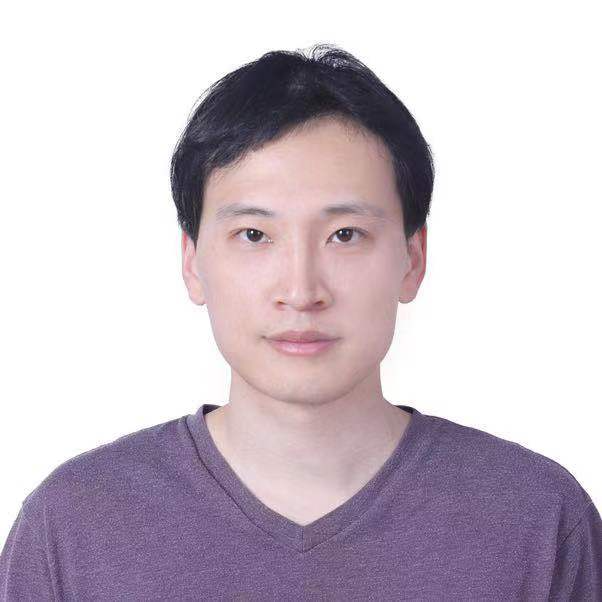
Yunfei MA
Researcher at XG Lab in the Alibaba Damo Academy
Talk Title
XLINK: Alibaba's Multi-path QUIC Transport for Large-scale Video Applications
Abstract: Despite vast research interests over the past decades, large-scale deployments of multi-path transport, such as MPTCP, have been slow over the public Internet due to unsatisfactory performance and high deployment costs. The emergence of QUIC as an end-to-end solution has brought the key opportunity to change the landscape. In this talk, I will present the design and implementation of XLINK, Alibaba’s QoE-driven multi-path QUIC transport solution. With a large-scale A/B test in Taobao short video services, XLINK demonstrates, for the first time, the feasibility, deployability, and benefits of multi-path transport in large-scale video services. With the proliferation of video applications and wireless technologies, the traditional one-size-fits-all approach that optimizes video and transport at independent layers will no longer satisfy the ever-growing diversity of the user perceived QoE. XLINK, which leverages the user-space nature of QUIC, pioneers innovations on a closer collaboration between video and wireless. The implications of such a QoE-driven approach extend beyond short videos and pave the way for exciting new avenues for exploration in multi-path transport such as long-form VoDs, live-streaming, AR, and VR.
Speaker Bio: Yunfei is currently a researcher at XG Lab in the Alibaba Damo Academy. Before joining Alibaba, He was a postdoctoral researcher at MIT Media Lab. His research explores and develops wireless technologies that extend human and computer abilities in sensing, communication and actuation. He received Ph.D. in Electrical and Computer Engineering from Cornell University and B.S. from USTC. In recent years, he has published more than 10 papers on top CS conferences including SIGCOMM, MOBICOM and NSDI and he holds more than 10 patents. His research has been covered by media outlets including BBC, The Verge, MIT Technology Review and IEEE Spectrum. He served on the TPC of ACM CoNEXT 2018, IEEE INFOCOM 2020/2019/2018 and IEEE Globecom 2021.

Kun TAN
Vice President of Central Software Institute, Huawei
Talk Title
Towards Compute-Native Networking
Abstract: TBA
Speaker Bio: Kun Tan is Vice president of CSI, heading the Distributed and Parallel Software Research Lab, Huawei. His research interests including networking, networked systems, and cloud computing.

Yongqiang XIONG
Senior principal researcher and research manager in MSRA
Talk Title
OpenNetLab: Open Networking Platform for Machine Learning Based Real Time Communications
Abstract: Leveraging AI to boost network application has attracted much attention in academia and the industry. Currently AI training is data-driven, and training AI models for networking demands massive amounts of real data with different environments. The quality and depth of the data determines the accuracy level of AI models a researcher can achieve. Until now, real network data have been far from enough to train an ideal model for network application, since the Internet, composed of heterogeneous access devices and switching devices, and transmission media provides a nearly unlimited number of scenarios. For example, RTC application requires precise network estimation to improve its quality of experience (QoE); however, due to network data deficiency, researchers still cannot provide an AI model to adapt to the variance of the bandwidth in the real network. To solve this issue, we are calling for a new research platform – OpenNetLab. OpenNetLab aims to build and provide a distributed networking platform with many collaborative nodes and a common benchmarking dataset (i.e. ImageNet in the networking area) for researchers to collect real networking data and train/evaluate their AI models for various networking environments, including the Internet/cloud, and wireless and mobile networks. Meanwhile, as an intra and platform, OpenNetLab also provides support for real networking experiments (e.g. DNS and CDN) in networking courses at universities, research projects (e.g. RTC/live streaming measurements) and online RTC challenges on MMSys’ 21 for Internet bandwidth estimation.
Speaker Bio: Dr. Xiong is now with Networking Researching Group at Microsoft Research Asia as a senior principal researcher and research manager. Dr. Xiong has been working on the system and networking area for a while, originally he worked on Internet routing protocols, after that, he turned to mobile ad hoc networks and peer-to-peer networks. He is now focusing on AI system infrastructure and data center networking systems, especially on the architecture design, optimal scheduling problem, switch constructions to improve resilience, performance and diagnosis, as well as its security problem such as handing the DDoS attacks. He is also interested in building hardware networking systems, doing measurement and security related research.
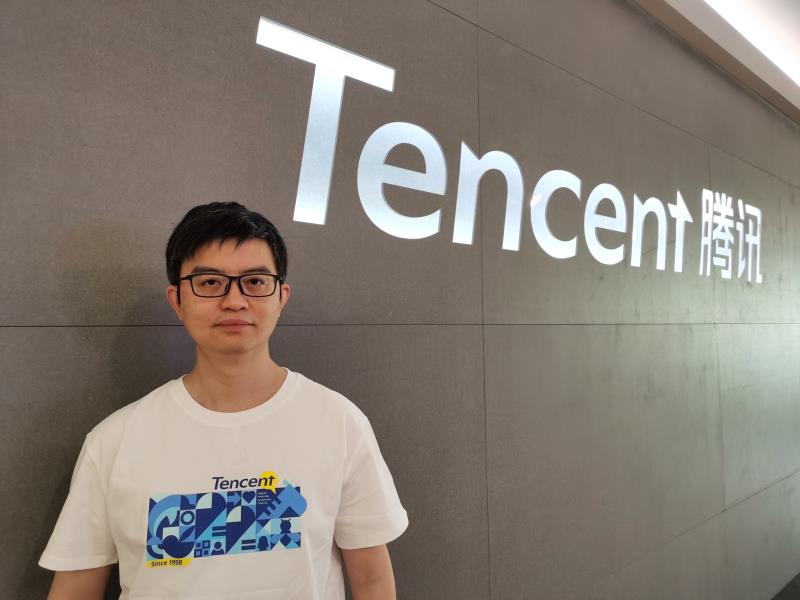
Feng YANG
Chief Architect of Tencent Cloud
Talk Title
Tencent Cloud cellular Network Accelerator (TCNA): a new paradigm for connecting to the cloud anywhere
Abstract: 5G is widely regarded as an enabler of next-generation networking technologies for tenants to access their cloud resources anywhere with guaranteed performance, which could address some of the issues incurred by conventional products (e.g. direct connect or VPN), such as long construction period, lack of QoS or mobility, etc. To explore the synergy between 5G and direct connect (DC), we have designed and showcased a novel cloud native networking solution, namely the Tencent Cloud cellular Network Accelerator (TCNA), featured with DC grade performance, support of mobility and being plug-and-play, characteristics that’re impossible to find all in any of the traditional networking approaches. We take advantage of 5G network slicing and guaranteed bit rate (GBR) to offer the tenant a stable and broadband private link to the Tencent Cloud. To guarantee service continuity, we have adopted a sophisticated high availability design, including dual tunnels, dual DCs with a single mobile operator and dual access gateways which make the system work properly in case of link or equipment failures. Test under China Mobile and China Unicom’s commercial 5G networks show that TCNA can bring a bi-directional bandwidth no less than 100Mbps and an end-to-end latency down to 10 ms, even when the network is heavy loaded.
Speaker Bio:Feng Yang received the Ph.D degree in electrical engineering from Tsinghua University in 2009. He is the chief architect of Tencent Cloud, leading the development of innovative edge computing and cloud networking technologies driven by 5G and beyond.

Abstract: Network management facilitates a healthy and sustainable network. However, its practice is not well understood outside the network engineering community. In this talk, I will present Facebook's network management suit, ranging from network planning, to risk-driven network management, and ultimately to network operation. I will present our intent-driven top-down network management automation that facilitates the network reliability, performance, and long-term evolution. By sharing our operational experiences of running a large-scale network for years, as well as our experiences in supporting a diverse set of networks from backbone, to PoP, to data center, we hope to inspire new research in the area of reliable and verifiable network management.
Speaker Bio: Ying Zhang is Software Engineering Manager in Facebook. She works on large scale network management problems and her research interests are in Software-Defined Networks, Network Function Virtualization, network monitoring, Internet routing, and network security. She has 30+ granted US/International patents, 50 peer-reviewed publications with about 1500 citations, and she was named by Swedish media as Mobile Network 10 Brightest Researcher. She was awarded as a Rising Star in the Networking and Communications area.